KEEP MOVING
How an unexpected keyboard stand malfunction can teach us a larger lesson about life and living. By D.D. Jackson

“Keep Moving,” was written after a performance with Ahmed Abdullah’s Diaspora during which pianist D.D. Jackson’s keyboard stand collapsed mid-set. He kept playing, and the moment became a parable for how try to approach things in life when unexpected circumstances come.
The piece was originally submitted, to Robert Roth’s And Then journal.
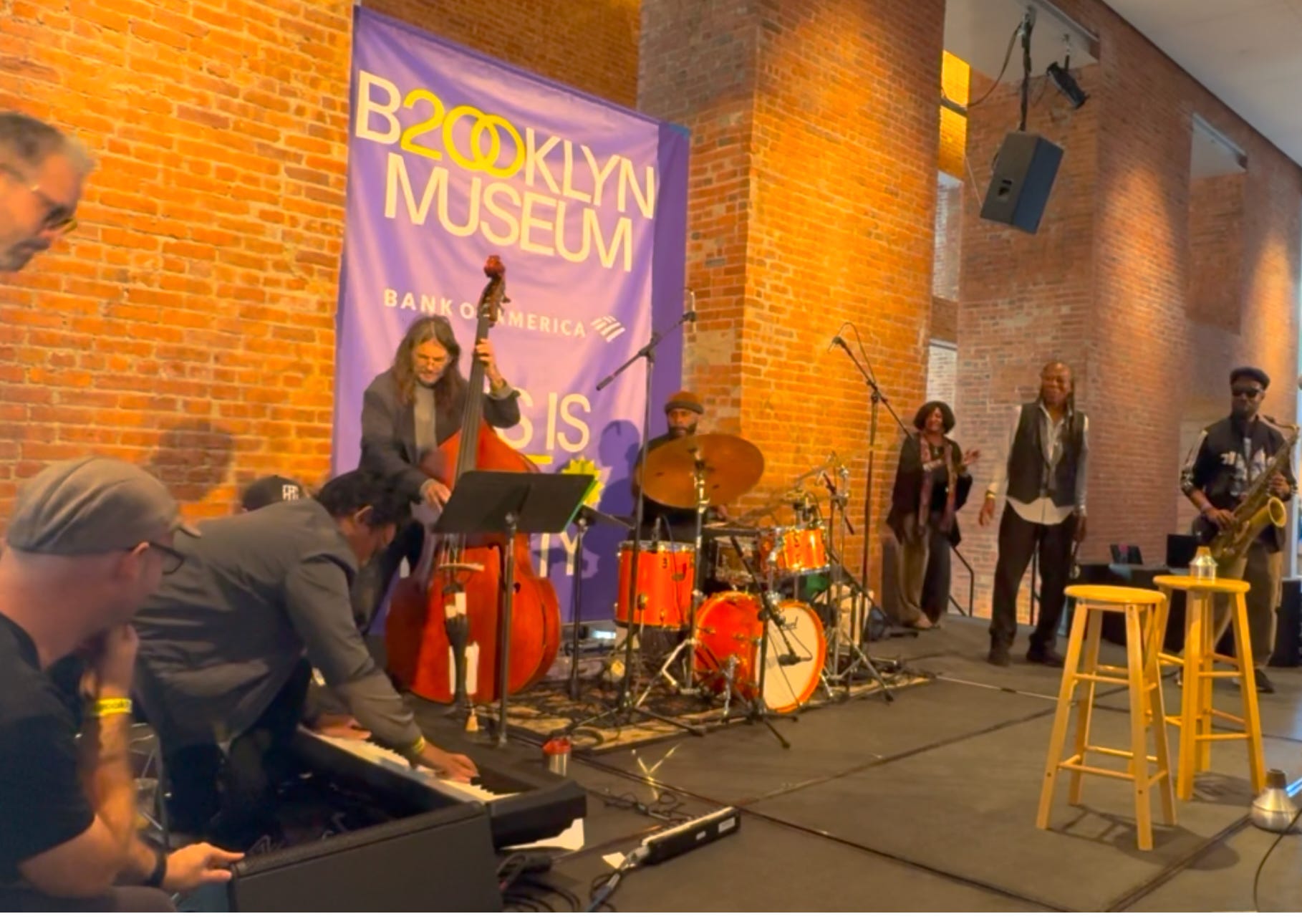
On Saturday, October 5th, 2024 I participated in what has become an almost ritualistic mainstay of my performing career - another appearance as pianist with trumpeter Ahmed Abdullah’s Diaspora (standing for: “Dispersions of the Spirit of Ra”, as Ahmed was a longstanding member of Sun Ra’s orchestra). This time the group was augmented almost whimsically by talented tap dancer Melissa Almaguer, and we were inaugurating a young drummer (Warren “Trae” Crudup) fresh from D.C. But it was the same, comforting, meditative material we’ve been playing for years - as always conjured up anew in the moment, always with unique variations, fresh avenues for exploration.
What I didn’t expect on this particular day was a novel monkey wrench thrown into the proceedings. The Brooklyn Museum hadn’t provided an acoustic piano, so I dutifully packed up and brought in my trusty Yamaha electronic piano instead. My ultimate instrument of choice is actually a Bösendorfer Imperial Concert Grand (used on seven of my recordings as a Bösendorfer Artist as well as at a recent release party event I just did in Toronto for my new album Poetry Project).
You can imagine, then, that many have in the past suggested to me that perhaps my aggressive playing technique might be “a bit much” for this “lowly” electronic keyboard I’ve occasionally had to trudge out on gigs. For this Brooklyn Museum appearance, though, it actually turned out not to be the keyboard but rather the (in hindsight) rickety keyboard stand that I’d brought to support it, that became the center of attention.
It was during our interpretation of Ahmed’s piece “Eternal Spiraling Spirit” where I was doing my usual calm-building-to-cacaphony sort of solo, for which this music is so well-suited. At the near-height of my solo, when I was admittedly tearing into the keyboard as I might a regular, full-fledged (and heartier) piano, I suddenly found myself temporarily playing air instead, as the stand—slowly creeping downwards throughout the course of my solo—finally gave way, plunging the keyboard to the floor.
Rather than stopping cold and spoiling the momentum, I kept playing—first leaning over severely from my chair to the keyboard now firmly on the ground—then, ultimately continuing to play as the stagehands waited for a strategic moment to intercede and raise the stand back up. I ended my solo shortly after the keyboard was restored, and could only smile at the fun of it and gesture appreciably to the band (who had also kept playing throughout, like nothing had happened).
Surprisingly, this “stand malfunction” proved surprisingly “viral” when I later posted a video I’d made of it to social media, raising in many the inevitable question of: “What was going through my mind when it happened”?
Let me me attempt to explain.
If I could sum up the philosophy of my approach to life, it would be to simply “keep moving,” a mantra that I repeat to myself often several times as I move through my day, and which I subconsciously invoked during that solo when the “unexpected” happened. These two words may seem simple, but to me, have surprisingly profound implications.
I often find, first of all, that jazz musicians tend to possess an “in the moment” mentality—the striving to ever “move forward”—almost to a fault. For me it means that events that happen before the “current moment”—even something as trivial as what I had for breakfast this morning—fade into the similarly gray haze of the distant past right after they first occur.
I often envy friends that have, in comparison, seemingly photographic memories for details, or even the occasional jazz musician that bucks this “forgetful” trend, such as multi-reed master James Carter, who can recall and play back a specific solo he heard on a specific day with uncanny accuracy. For me, in contrast, it all blurs into the “before” and my focus tends to be on the new; on embracing the “now,” and the future.
Certainly, this phenomenon has aided me in my other life as a Emmy-winning composer for television, where I am often called upon to write something inspired by, but not a direct copy of, some other existing musical reference (or list of references). The sheer haziness of my specific recollection allows me to instead extract just the “conceptual essence” of the source material, which, when merged with my own particular sensibilities, results in something new.
This “ever-forward” focus has also become a strategy for getting things accomplished in general, particularly when faced with a crazy deadline as a composer. My thought process always goes something like this: 1) endure the pain of sleepless, multiple night marathons; 2) let time march forward with proactive action, and 3) instead of otherwise “twiddling my thumbs” I might just birth a brand new song or other creation into the world that wouldn’t have been there before. The time is going to pass anyway, so I might as well “keep moving” and get something done in the process!
When applied to the realm of jazz performance, my striving to “keep moving”and to embrace the moment also conjures up a state where my emotions are ultra-heightened; where I almost become a member of the audience myself, reacting to whatever I just created in the moment. It’s the world’s greatest natural high and a feeling I relish, instantly justifying long travel times, rehearsals, and all of the other relative “hardships” that may have led to that moment.
There are, of course, many times where this mentality can be taken to an extreme. I often find myself having to “come down” after a period of such heightened focus, whether from a performance or from a very focused several day project such as writing a song for TV.
But in that moment, at the Brooklyn Museum, my desire for forward momentum certainly meant that I wouldn’t be stopped by something as simple as a keyboard stand malfunction! I was fully in the moment, inspired by the spirit of the band, and wanted to “keep moving” - so I did.
- D.D. JACKSON